
- File Timestamping
- Timestamping
- Proof of existence
- Bitcoin
- Guides
Free Blockchain Timestamp: 8 Services Compared (2026)
Free ways to timestamp a file on the Bitcoin blockchain, plus faster non-blockchain options, compared: cost, sign-up, time to proof and independent checking.
By PickZeal
Updated 11 min read
Key takeaways
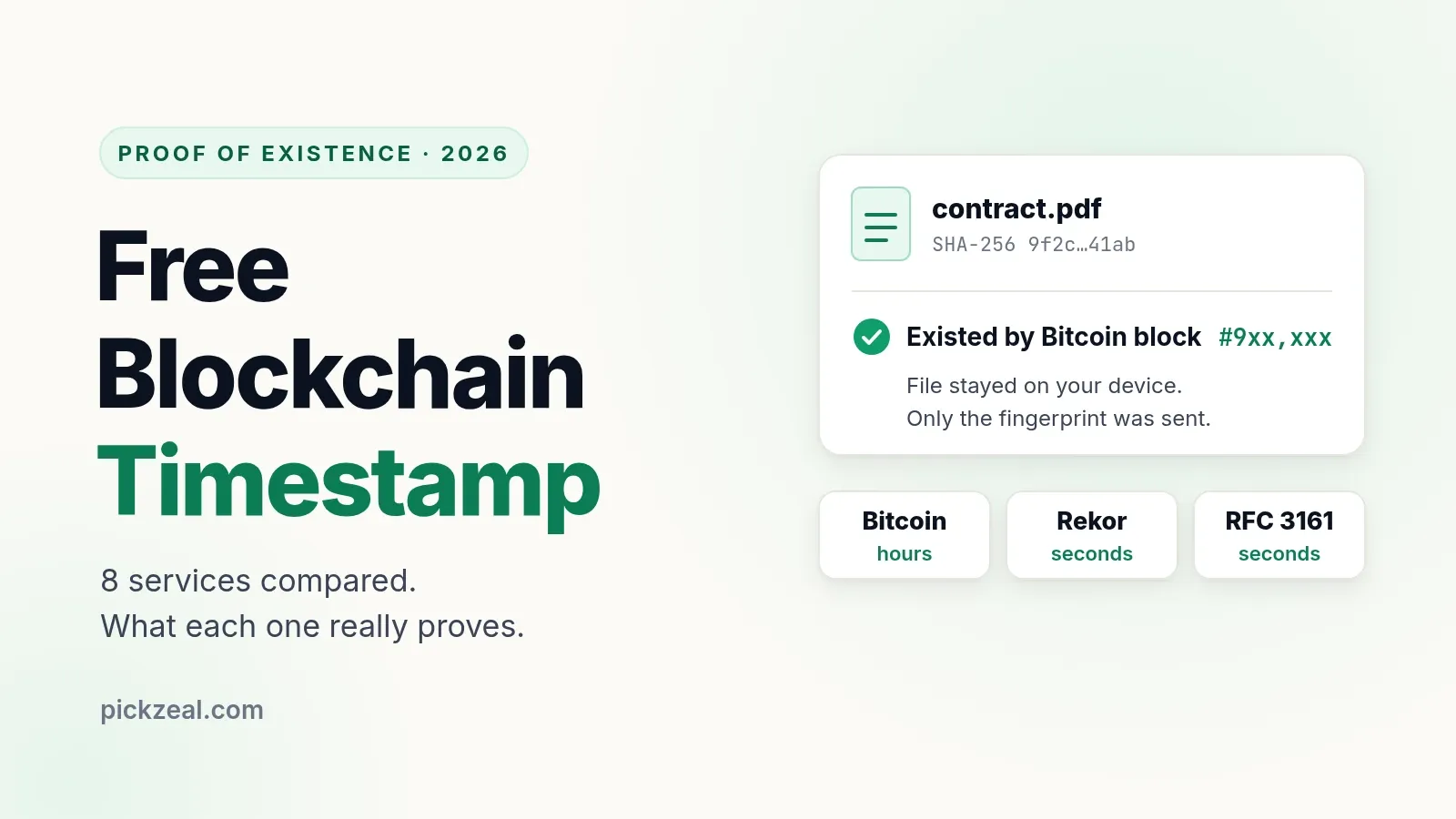
- You can timestamp any file on the Bitcoin blockchain for free with OpenTimestamps. Its public calendar servers batch thousands of fingerprints into one transaction, so there is no fee, no account and no crypto wallet.
- Only the file's SHA-256 fingerprint is sent. The file stays on your device, and the proof is a small .ots file you keep next to it.
- A Bitcoin timestamp takes a few hours to confirm. If you need proof in seconds, use Sigstore Rekor or a free RFC 3161 authority such as FreeTSA instead, or as well.
- A timestamp proves a file existed no later than a date and has not changed since. It does not prove who made it.
- The test of a good free service: can you verify the proof without that service? OpenTimestamps proofs pass, whichever website created them.
The best free blockchain timestamp is OpenTimestamps. It records a fingerprint of your file in the Bitcoin blockchain at no cost, with no account and no crypto wallet, and the proof it gives you can be checked by anyone, even if the website you used disappears. You can use it on opentimestamps.org, with its command-line client, or through free web pages that make it easier, such as PickZeal’s Bitcoin Timestamp.
A Bitcoin timestamp takes a few hours to confirm, though. If you need proof in seconds, the free non-blockchain options in this guide, a public transparency log and RFC 3161 timestamp authorities, are faster.
This guide compares eight free options: what each costs, whether you need to sign up, how long it takes, what you get back, and the most important question, whether you can verify the proof without that service. Prices and terms were checked on each service’s own website on November 22, 2026. For the wider topic, see our guide on how to prove a file existed on a date.
The short answer: which free timestamp to use
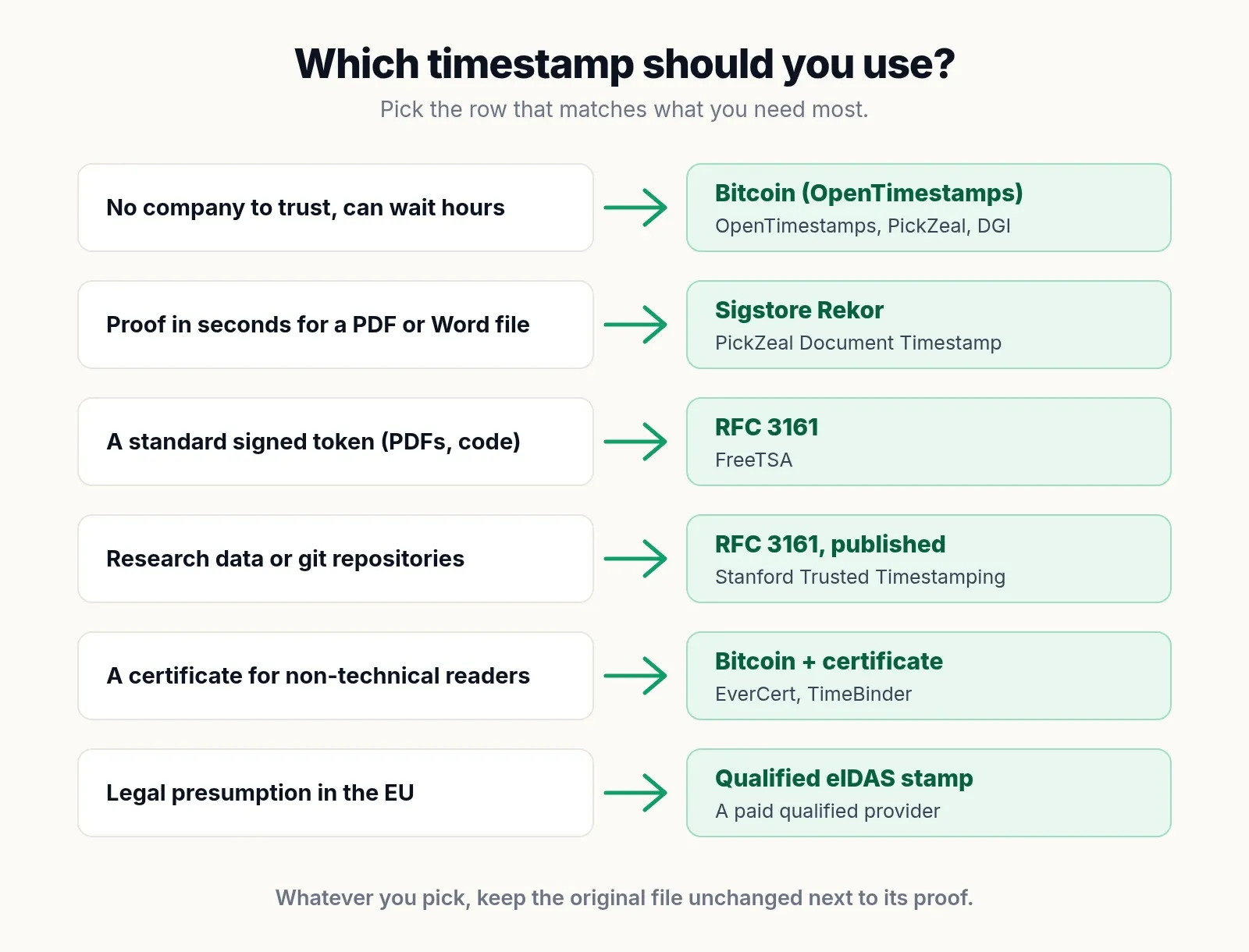
| What you need | Use | Cost |
|---|---|---|
| Proof that depends on no company | Bitcoin, via OpenTimestamps | Free |
| Proof in seconds for a PDF or Word file | Sigstore Rekor | Free |
| A standard signed timestamp token | RFC 3161, via FreeTSA | Free |
| Timestamps for research data or git repositories | Stanford Trusted Timestamping | Free |
| A certificate to show non-technical people | EverCert or TimeBinder | Free tier |
| A legal presumption of accuracy in the EU | A qualified eIDAS timestamp | Paid |
For an important file, use two methods: a fast one such as Rekor for proof today, and Bitcoin for proof that does not depend on anyone staying in business.
What a blockchain timestamp proves, and what it does not
A timestamp works on a fingerprint of your file, called a SHA-256 hash: a 64-character code that changes completely if a single byte of the file changes. The service records that fingerprint at a point in time. Later, anyone can fingerprint the file again and compare.
A timestamp proves:
- This exact file existed no later than the recorded time.
- The file has not been changed since.
It does not prove:
- Who made the file. Nothing in the record is linked to your name.
- That the file did not exist earlier. The date is an upper limit, not the moment of creation.
- That the contents are true, original or legally valid.
This is why timestamps are used by songwriters, designers, writers, researchers and developers to show that they had a piece of work by a certain date, often alongside other evidence such as drafts, emails and contracts.
Free blockchain timestamp services compared
| Service | Method | Cost | Sign-up | Time to proof | Proof you keep | Verify without the service? |
|---|---|---|---|---|---|---|
| OpenTimestamps | Bitcoin | Free | No | A few hours | .ots file | Yes |
| PickZeal Bitcoin Timestamp | Bitcoin, via OpenTimestamps | Free | No | A few hours | .ots file | Yes |
| DGI OpenTimestamps page | Bitcoin, via OpenTimestamps | Free | No | About an hour, per DGI | .ots file | Yes |
| EverCert | Bitcoin, via OpenTimestamps | Free launch plan | No | About a week, per EverCert | Certificate and .ots file | Yes |
| TimeBinder | Bitcoin | 1 free a month, then from $5 | Email or Google | Not instant | Certificate | Not stated on its site |
| PickZeal Document Timestamp | Sigstore Rekor (public log) | Free | No | Seconds | Receipt (.json) | Yes, via the public log |
| FreeTSA | RFC 3161 authority | Free | No | Seconds | Timestamp token (.tsr) | Yes, with OpenSSL |
| Stanford Trusted Timestamping | RFC 3161, published daily | Free | No | Seconds | Timestamp token | Yes |
The first five use a blockchain. The last three do not, but they are free, fast, and solve the same problem, so they belong in the comparison.
The eight options, one by one
1. OpenTimestamps: the free standard
OpenTimestamps is an open standard and free service for timestamping on the Bitcoin blockchain. Its website hashes your file in the browser and downloads a proof, and its command-line client does the same from a terminal. It runs four public calendar servers that are free to use, need no registration or API key, and are funded by donations. Dozens of companies build on it.
Its strength is independence: a complete OpenTimestamps proof can be checked against the Bitcoin blockchain with open-source software, without trusting OpenTimestamps or anyone else. For the strongest check, the official client verifies against your own Bitcoin node.
The trade-off is that it is a little technical. The proof is a small binary file, and a new proof is pending until it is upgraded a few hours later.
2. PickZeal Bitcoin Timestamp: OpenTimestamps in your browser
PickZeal’s Bitcoin Timestamp is a free page that makes OpenTimestamps easier to use. It creates a timestamp, verifies an .ots proof and upgrades a pending proof, all in the browser, with step-by-step guidance. PickZeal does not run the OpenTimestamps network and does not receive your file, its fingerprint or the proof; your browser talks to the public calendar servers directly. Proofs use the standard format, so they also work with the official client.
3. DGI’s OpenTimestamps page
The Digital Gold Institute offers another free web interface to OpenTimestamps, where one box stamps a file, upgrades a receipt or verifies a proof against Bitcoin block explorers. DGI says a new receipt can usually be upgraded after about an hour. Like the others built on OpenTimestamps, it produces standard proofs you can verify elsewhere.
4. EverCert: free certificate on top of OpenTimestamps
EverCert hashes your file in the browser, anchors it through the public OpenTimestamps calendars, and gives you a certificate plus the .ots proof. Its plan is free during its launch, with paid features planned later. EverCert says final Bitcoin anchoring “typically completes in ~1 week”, which is slower than other OpenTimestamps tools, but the proof is a standard one that you can verify independently.
5. TimeBinder: certificates with a free monthly allowance
TimeBinder hashes files in the browser, anchors fingerprints to Bitcoin and gives you a “Proof of Time Certificate” designed for people who are not technical. Its free plan includes one pooled timestamp a month and requires signing in with email or Google. Beyond that, single timestamps cost $5 (pooled) or $15 (faster), and monthly plans start at $20. Choose it if a polished certificate matters more to you than the raw proof file.
6. PickZeal Document Timestamp: proof in seconds with Sigstore Rekor
PickZeal’s Document Timestamp is a free page that records a PDF or Word file’s fingerprint in Rekor, the public transparency log run by the open-source Sigstore project. Rekor is not a blockchain: it is an append-only public log built on a Merkle tree, the same kind of structure. The difference is speed. The entry is recorded in seconds, and anyone can look it up later by its log index or by the file’s hash, without PickZeal.
The trade-off is trust: the recorded time comes from Rekor, so you rely on Sigstore’s operators and the public, append-only log rather than on a blockchain. Entries are public and permanent.
7. FreeTSA: free RFC 3161 timestamps
FreeTSA is a free timestamp authority under RFC 3161, the internet standard for trusted timestamps. You send a fingerprint, and it returns a token signed with its certificate and its clock. You can use its online form, which keeps the file in your browser, or OpenSSL from the command line, and verify the token later with FreeTSA’s public certificates. RFC 3161 tokens are also what PDF signing tools and code signing use.
Speed is its strength: a few seconds. Its weakness is that you trust one authority and its certificate. FreeTSA renewed its certificate in March 2026, and timestamps from then are valid until 2040.
8. Stanford Trusted Timestamping: for research data
Stanford’s Trusted Timestamping site timestamps files, whole folders, text or a hash, using RFC 3161 timestamp authorities. The hashing happens in the browser, and the submitted hashes are published every day in a public GitHub repository, which adds an independent public record. The project also offers git hooks that timestamp every commit, which suits lab notebooks and research code.
Paid options worth knowing
- OriginStamp: a commercial timestamping service with an API that anchors to Bitcoin and other blockchains.
- blockchainsign: timestamps on Ethereum, at $9.99 per document.
- Qualified eIDAS timestamps: paid services from regulated EU providers, the only kind with a built-in legal presumption in the EU.
Why a blockchain timestamp can be free
Recording data in Bitcoin costs a transaction fee, so how can it be free? OpenTimestamps’ calendar servers collect fingerprints from many users, combine them into one Merkle tree, and record only the tree’s root in a single Bitcoin transaction. One small fee covers thousands of timestamps.
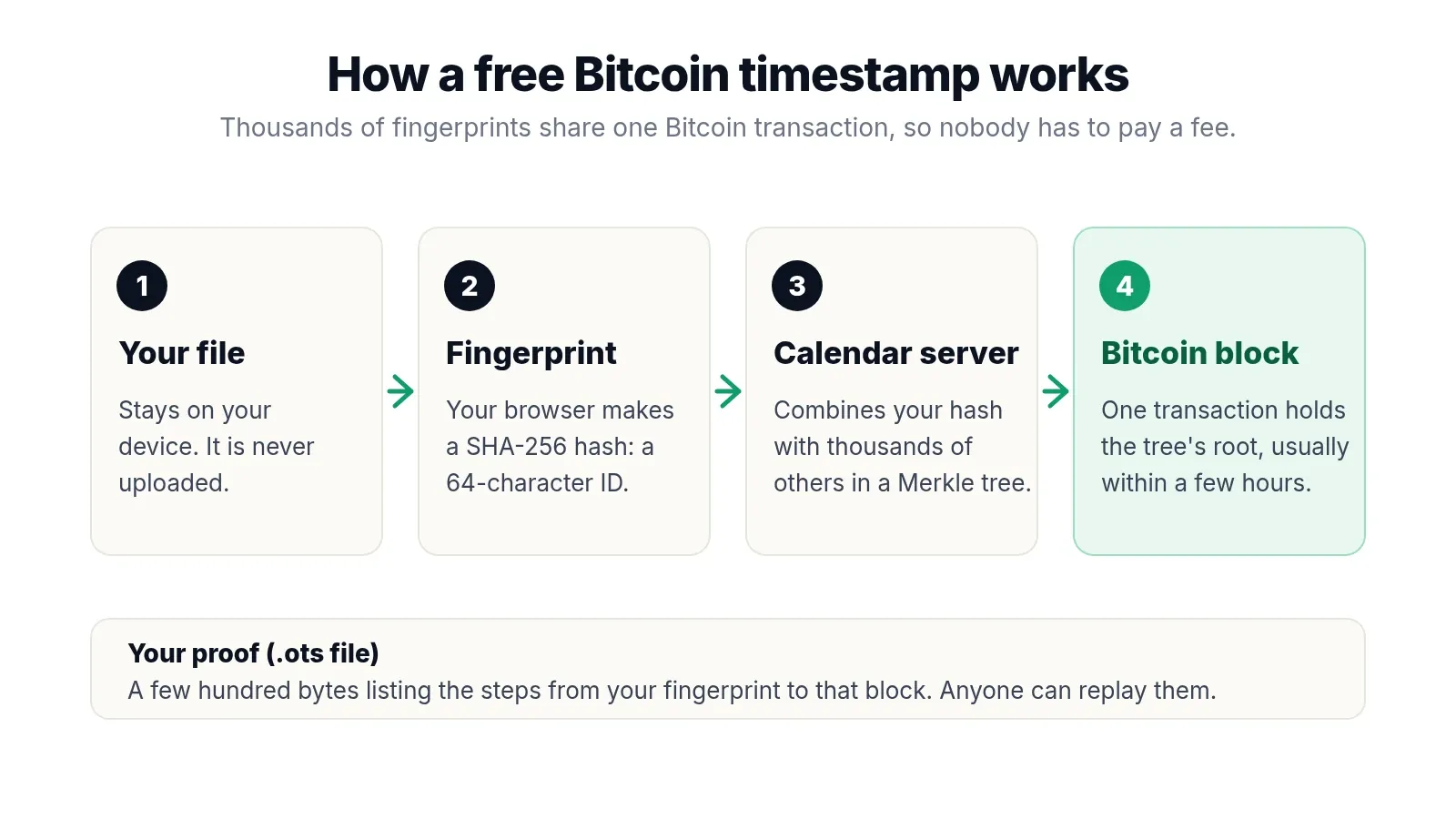
Your proof is the short list of steps from your fingerprint to that root, about a few hundred bytes. Anyone can replay the steps and check that they end at the root stored in a real Bitcoin block.
Blockchain vs Rekor vs RFC 3161: who you have to trust
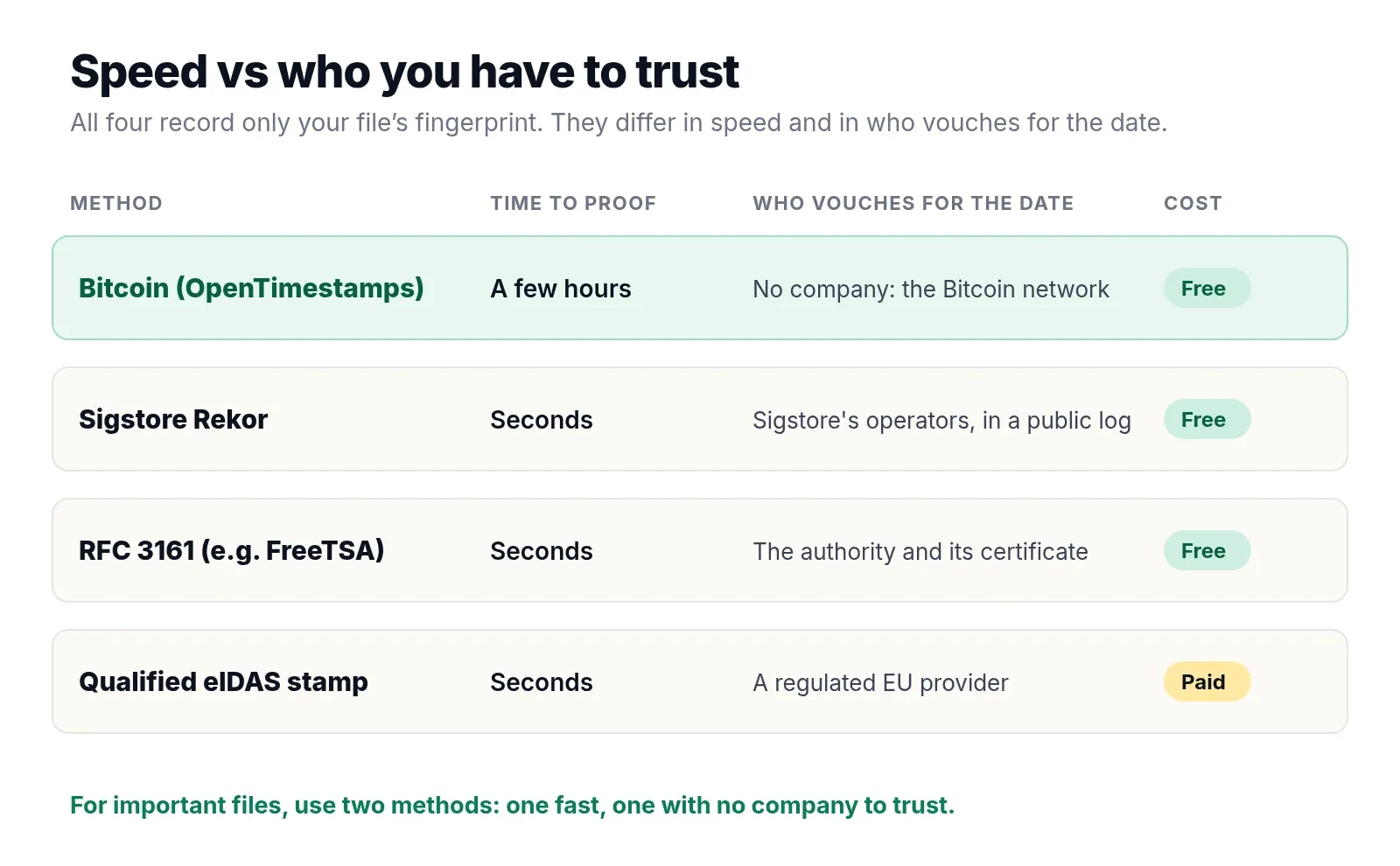
| Method | Time to proof | Who vouches for the date | Cost |
|---|---|---|---|
| Bitcoin (OpenTimestamps) | A few hours | No company: the Bitcoin network | Free |
| Sigstore Rekor | Seconds | Sigstore’s operators, in a public log | Free |
| RFC 3161 authority | Seconds | The authority and its certificate | Free (FreeTSA) |
| Qualified eIDAS timestamp | Seconds | A regulated EU provider | Paid |
No single method wins on everything. Bitcoin is the hardest to fake but the slowest. Rekor and RFC 3161 are instant but rely on an operator. That is why using two methods for an important file is cheap insurance.
How to timestamp a file for free, step by step
Using OpenTimestamps through PickZeal’s Bitcoin Timestamp:
- Finish the file first. Any later change, even re-saving it, creates a different fingerprint.
- Add the file to the tool. Its SHA-256 fingerprint appears immediately; the file is not uploaded.
- Create the timestamp and download the
.otsproof. Save it next to the file. - Come back a few hours later, add the file and the proof, and upgrade the proof. Keep the upgraded version.
- Store both together, ideally in two places, and keep the file read-only.
For instant proof of a PDF or Word file, do the same with the Document Timestamp tool and keep its receipt.
Prefer the command line? OpenTimestamps’ official client does the same:
pip3 install opentimestamps-client
ots stamp contract.pdf          # creates contract.pdf.ots
ots upgrade contract.pdf.ots    # a few hours later
ots verify contract.pdf.ots     # checks against your own Bitcoin node
How to verify a timestamp later
To verify, you need two things: the original, unchanged file and its proof. The check recomputes the file’s fingerprint, replays the proof and compares the result with the public record: a Bitcoin block, a Rekor entry or an authority’s signature.
The most common reason a check fails is not fraud but a changed file. Opening a Word document and saving it again, re-exporting a PDF, or letting a cloud drive convert the file all create new bytes and a new fingerprint. Timestamp the final version, and keep that exact copy.
Free vs paid: when paying makes sense
For most people, the free options are enough: the underlying proof from a free OpenTimestamps tool is the same kind of proof a paid Bitcoin service produces. Paying can make sense when:
- You need a certificate that a non-technical reader, client or judge can understand at a glance.
- You need a legal presumption. In the EU, only qualified timestamps from regulated providers get one.
- You timestamp at scale and want an API, integrations and support.
- You want someone else to keep the records for you, rather than storing proof files yourself.
Is a blockchain timestamp legally valid?
This section is general information, not legal advice.
A timestamp is evidence, and how much weight it carries depends on the country, the court and the rest of your evidence. Some examples of how the law treats electronic timestamps:
- European Union: under the eIDAS Regulation (Article 41), an electronic time stamp cannot be denied legal effect or refused as evidence just because it is electronic or not “qualified”. Only qualified electronic time stamps get a legal presumption that the date and the data are accurate.
- United States: since 2017, Federal Rule of Evidence 902(14) allows data copied from an electronic device or file to be self-authenticating when it is certified and identified by a “process of digital identification”, which in practice means a hash.
A blockchain timestamp strengthens a claim that you had a file by a certain date, especially alongside drafts, messages and witnesses. For anything with real stakes, such as a patent, a contract dispute or a copyright case, ask a lawyer which kind of timestamp and records your jurisdiction expects.
Which one should you use?
How we compared these services
- Prices, plans and sign-up requirements were checked on each service’s own website on November 22, 2026. Small services change their terms often, so check before relying on a free plan.
- Time to proof is what each service states, or for OpenTimestamps, its usual behavior; Bitcoin confirmation time varies with network fees.
- “Verify without the service” means the proof can be checked with open-source tools and a public record, such as the Bitcoin blockchain, the Rekor log or a public certificate, without the company that created it.
- About PickZeal’s tools: two options in this list are free PickZeal pages that make OpenTimestamps and Sigstore Rekor easier to use. PickZeal does not run those networks, charges nothing, and does not receive your files. We included every other option on the same terms.
Frequently asked questions
Is there a free blockchain timestamp?
Yes. OpenTimestamps timestamps files on the Bitcoin blockchain for free, with no account. You can use it on opentimestamps.org, with its command-line client, or through free web pages built on it such as PickZeal's Bitcoin Timestamp and DGI's OpenTimestamps page. Your file stays on your device; only its fingerprint is sent.
Is OpenTimestamps really free?
Yes. OpenTimestamps runs public calendar servers that collect fingerprints from many users, combine them into one Merkle tree and record its root in a single Bitcoin transaction. The calendars pay that one small fee and are funded by donations, so each user pays nothing and does not need to register.
How long does a Bitcoin timestamp take?
You get a pending proof immediately, and it is usually confirmed in a Bitcoin block within a few hours, because the calendar servers batch fingerprints and wait for low fees. When fees are high it can take longer. A pending proof can be upgraded to a complete one at any later time.
Do I need cryptocurrency or a wallet to timestamp a file on the blockchain?
No. Free services such as OpenTimestamps pay the Bitcoin transaction fee for you by batching many fingerprints into one transaction. You never need a wallet, an exchange account or any cryptocurrency, either to create a timestamp or to verify one.
Can anyone see my file if I timestamp it on a blockchain?
No. Only a SHA-256 fingerprint of the file is recorded, and a fingerprint cannot be turned back into the file. OpenTimestamps also adds a random value before sending it, so nobody can match the record to your file. Keep the file private if its contents are confidential.
What happens to my timestamp if the service shuts down?
A complete OpenTimestamps proof depends only on the Bitcoin blockchain, so it stays valid even if the website that created it disappears. Keep the original file and the .ots proof together. A pending proof, however, still needs the calendar servers to be upgraded, so upgrade it within a few days.
Is a Bitcoin or Ethereum timestamp better?
Bitcoin is the most common choice for timestamping because of its long history and the free OpenTimestamps network. Ethereum timestamps work the same way in principle, but the free tools are fewer and most Ethereum services charge per document. What matters most is that you can verify the proof independently.
Is a blockchain timestamp legally valid?
In many places a blockchain timestamp can be used as evidence, but how much weight it carries depends on the country and the court. In the EU, electronic time stamps cannot be refused as evidence just because they are electronic, while only paid qualified time stamps get a legal presumption of accuracy. This is not legal advice; ask a lawyer for important cases.
Sources
- OpenTimestamps: stamp and verify, calendars and client
- DGI: OpenTimestamps web interface
- EverCert: pricing
- TimeBinder: plans and how it works
- FreeTSA: free RFC 3161 time stamp authority
- Stanford Trusted Timestamping (source and public record)
- Sigstore Rekor transparency log
- RFC 3161: Time-Stamp Protocol
- Regulation (EU) No 910/2014 (eIDAS), Article 41
- US Federal Rules of Evidence, Rule 902
Topic
More on File Timestamping
- Document TimestampProve a PDF or Word file existed on a date. Its SHA-256 hash is recorded in the public Sigstore Rekor log. Free, and the file never leaves your device.
- Bitcoin Timestamp (OpenTimestamps)Timestamp any file on the Bitcoin blockchain with OpenTimestamps, then verify or upgrade the .ots proof. Free, and your file never leaves your device.